Training Your Dog for Charlotte's Weather and Terrain
General training information. For aggression, sudden behavior changes or health concerns, see your veterinarian first.
Charlotte is a great city for dogs. It has greenways, neighborhood sidewalks, and county dog parks. It also has long, hot summers and a real tick presence. Good Charlotte dog safety is partly about gear and timing, and partly about teaching your dog a few calm habits that make the weather easier to manage.
This guide covers the two hazards with clear local documentation: summer heat on hot pavement, and ticks. For each one, you will find what it is, who says so, and the reward-based training that helps. Everything here uses treats, praise, and patience. Nothing here needs force or harsh tools, which matches the guidance of the American Veterinary Society of Animal Behavior (AVSAB).
What You Need
- A standard flat collar or a well-fitted harness, plus a regular leash. Charlotte's leash rules (below) apply on every walk.
- Small, soft treats your dog loves, cut to pea size.
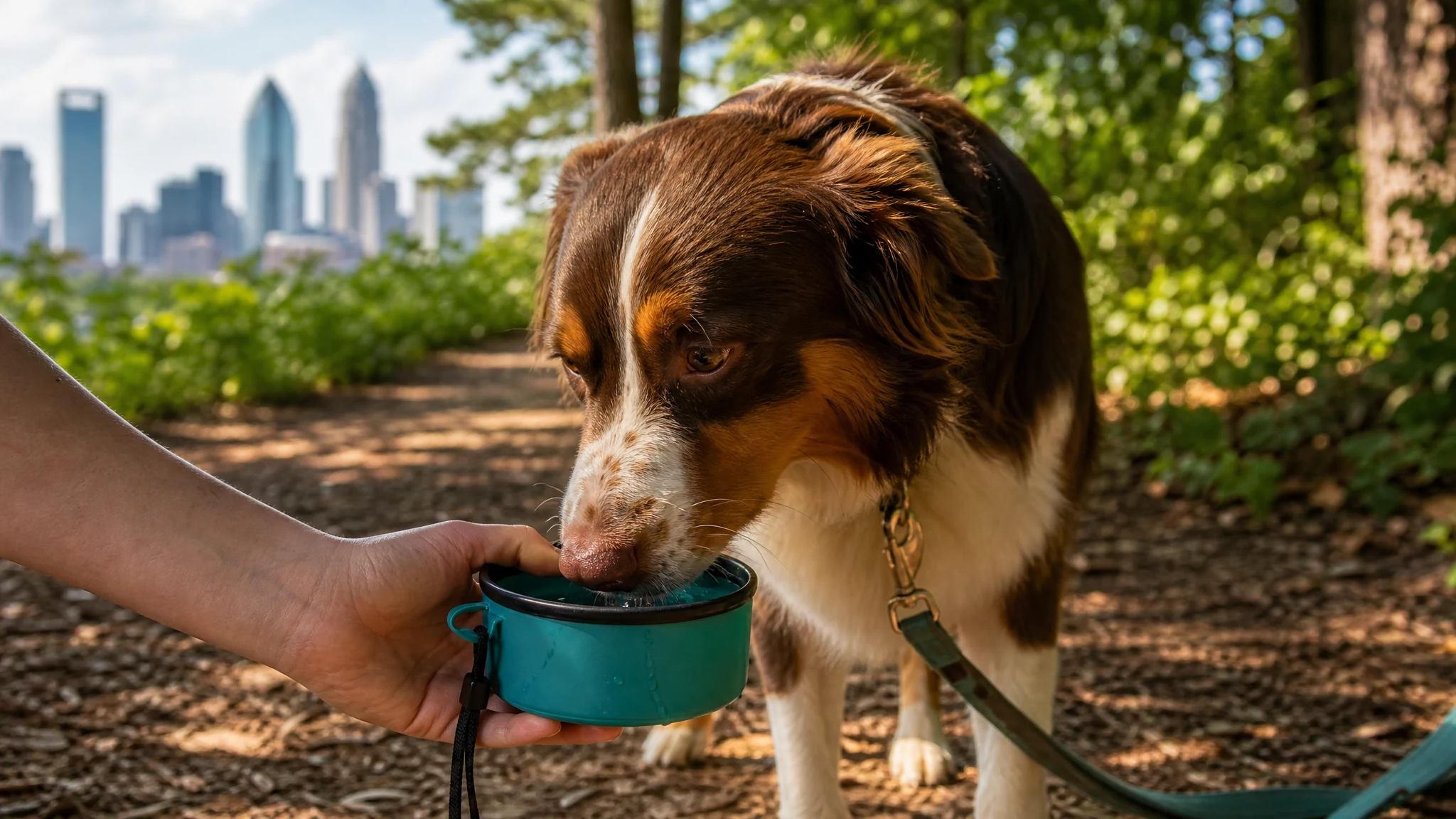
- A portable water bowl and fresh water.
- A towel for wiping paws and cooling off after walks.
- A clicker or a short marker word such as "yes," if you like to use one.
- A tick preventive chosen with your veterinarian.
- About five to ten minutes a day for short practice sessions.
Know the Local Rules First
Training for Charlotte's terrain starts with the basics of the law. According to the City of Charlotte Animal Care and Control Mecklenburg County Animal Ordinance page, dogs must be kept on a leash and under physical restraint at all times when off the owner's property. A fence or a marked, operable invisible fence also counts as containment on your own property. The same page lists a $50 citation for a first violation. It does not state a maximum leash length, so check with Animal Care and Control if you have questions.
Dogs and cats four months and older also need a pet license in Charlotte, and the city's Pet License page says proof of a current rabies vaccination is required. North Carolina G.S. 130A-185 requires rabies vaccination for dogs over four months old. Keep those records handy, since they matter again if you visit a county dog park.
Hazard One: Summer Heat and Hot Pavement
What it is and what the agency says
Walking a dog in heat is the most common summer risk for Charlotte owners. In a June 2025 WSOC-TV report, Charlotte Mecklenburg Animal Care and Control advised avoiding hot pavement or asphalt at peak heat, because it can burn paws. The agency also advised walking pets in cooler hours, either early morning or late evening. It said never to leave pets in parked cars, and to bring pets indoors in extreme heat. The report says that failing to do so may lead to animal abuse charges in the county.
That makes hot pavement a real concern for dogs on sidewalks, parking lots, and street crossings. Training helps because a dog that cooperates with a simple routine is easier to keep safe.
Step 1: Build a cooperative paw-handling habit
You cannot check for heat damage if your dog pulls away every time you touch a foot. Start in a quiet room.
- Touch your dog's shoulder, say "yes," and give a treat.
- Slide your hand down the leg a little at a time. Reward each small step.
- Touch the paw for one second, then reward. Build to gently holding it for a few seconds.
- Once your dog is relaxed, lightly spread the toes and look at the pads. Reward again.
Keep sessions short. If your dog pulls away, you went too fast, so go back one step. Many dogs get comfortable within a couple of weeks of daily practice, though every dog is different.
Step 2: Teach a "wait at the curb" and a "this way" cue
Pavement can be hot in one spot and cool in the next. You want to be able to steer your dog onto grass or shade without a tug-of-war.
- Start indoors. Say "this way" in a cheerful voice, take a step in a new direction, and reward your dog the moment they follow.
- Practice in the yard, then on a quiet street.
- At the curb, pause, ask for a sit, and reward. This gives you a moment to check the surface.
Use the back of your own hand on the pavement. If it feels too hot to hold there comfortably, it is too hot for paws. Choose grass, shade, or a different time of day.
Step 3: Make cool-down a routine
A calm cooling routine helps both of you after a warm walk.
- Walk to a shaded spot and ask for a settle on a mat or towel.
- Offer water and let your dog drink at their own pace.
- Wipe the paws with a damp towel while your dog practices the paw handling you taught in Step 1.
- Reward calm behavior throughout.
Teaching a relaxed "settle" on a mat also helps in the car, at a patio, or at the vet. Never leave your dog in a parked car, even for a short errand.
Step 4: Consider gradual booties practice
Some owners choose dog booties for hot surfaces. If you try them, treat them as a training project and ask your veterinarian first whether they suit your dog.
- Let your dog sniff one bootie and reward. Repeat over a few days.
- Touch a bootie to a paw, reward, and remove it.
- Fasten one for a few seconds while treating, then take it off.
- Slowly add more booties and more time, indoors first.
Booties do not replace common sense. Shifting your walks to early morning or late evening, as the agency advises, is still the main plan.
Hazard Two: Ticks
What it is and what the sources say
A 2020 WFAE report on ticks in North Carolina says the blacklegged tick has been found in Mecklenburg County. It also says Rocky Mountain spotted fever occurs largely in central and eastern North Carolina. The Lone Star, brown dog, and American dog ticks also occur in the state. Because that report is from 2020, ask your veterinarian what is current in your part of town.
NC State Extension's entomology program advises using a product that works on both fleas and ticks, chosen with a veterinarian, and not combining products. Follow that advice, and ask your vet before you start or change any preventive.
Step 5: Teach a "leave it" for brush and wildlife
Ticks live in tall grass and brush, so a dog that can skip the weeds and wildlife smells is lower risk. "Leave it" is useful far beyond ticks.
- Hold a treat in a closed fist. Let your dog sniff and paw at it.
- The moment your dog pulls away, even briefly, say "yes" and reward from your other hand.
- Repeat until your dog looks away from your fist on their own.
- Say "leave it" just before presenting the fist. Then try it with a treat on the floor under your foot.
- Take it outside. Practice near a grassy edge, rewarding your dog for turning back to you.
Step 6: Practice a reliable recall on a leash
Since leashes are required off your property, practice recall on a regular leash or a fenced yard. A good recall lets you call your dog out of the weeds without a chase.
- Pick a happy word such as "come." Say it once, then back up a few steps.
- When your dog reaches you, reward generously. Make coming to you the best thing that happens all day.
- Add distance and mild distractions a little at a time.
- Never call your dog to you for something unpleasant. If you need to do a tick check, make it a treat party.
Step 7: Make the after-walk body check a game
Right after walks in grassy or wooded areas, run your hands over your dog while rewarding calm behavior. Check around the ears, between the toes, under the collar, and in the armpits. Pair it with the paw handling from Step 1. If you find a tick, ask your veterinarian how to remove it and what to watch for afterward.
Putting It Together on a Charlotte Walk
- Choose early morning or late evening in warm weather.
- Check the pavement with the back of your hand.
- Bring water and offer it during and after the walk.
- Use "this way" to steer onto grass or shade.
- Use "leave it" to skip brush and wildlife smells.
- Finish with a settle, a paw wipe, and a quick body check.
A Note on County Dog Parks
Mecklenburg County Park and Recreation runs several dog parks, including Davie Dog Park at William R. Davie District Park, Frazier Park Dog Park, Shuffletown Dog Park, and Clarks Creek Dog Park. The county's dog park page lists daily hours of 7:30 a.m. to sunset. It requires current rabies (with tag number), DHLPP, and Bordetella vaccinations, and it does not allow children under 12.
Plan visits for cooler hours, and bring water. Check with Mecklenburg County Park and Recreation for each park's current details, since park-specific rules and fees were not listed on the pages we cite.
Tips for Success
- Keep sessions to five minutes and end while your dog is still enjoying them.
- Practice each skill in a quiet place before expecting it on a busy greenway.
- Use higher-value treats outdoors than you use at home.
- Stay consistent with cues. Everyone in the household should use the same words.
- Watch your dog's body language. Heavy panting, slowing down, or seeking shade means it is time to stop.
Common Mistakes to Avoid
- Walking at midday in summer. The agency's advice is to use cooler hours.
- Assuming shoes protect from everything. Booties take gradual practice and are not a license to walk in peak heat.
- Rushing paw handling. Pushing past your dog's comfort teaches them to avoid it.
- Using a recall cue to end fun every time. Sometimes call your dog, reward, and let them go back to play.
- Combining tick products on your own. NC State Extension advises against this. Talk to your veterinarian.
- Punishing a dog for pulling away or refusing. It makes handling harder, not easier.
What to Expect
With steady practice, many dogs learn to tolerate paw checks, respond to a "leave it," and settle after walks more calmly. These habits may make hot-weather routines and post-walk checks easier. Progress varies with age, temperament, and history, and no training plan can promise a particular outcome.
If your dog shows signs of heat distress, collapses, or has a sudden health or behavior change, see a veterinarian right away. If your dog growls, snaps, or bites people during handling or at any other time, contact your veterinarian and a certified behavior professional rather than trying to fix it alone.
Getting Help
If you want hands-on help with recall, leash skills, or handling, a local class can speed things up. Our guide on dog training in Charlotte: classes, costs, and how to choose explains what to look for and what to ask.
For serious behavior concerns, Charlotte has credentialed behavior professionals. Camille D Asmer of Canine Behavior Solutions, at 6600 Brookmeade Dr., Charlotte, NC 28226, is listed with the IAABC-CDBC credential, along with IAABC-ADT and CCPDT CBCC, on dogtrainerlocator.com. Angie Cook of Canine Cohesion Behavior Services is listed there with a CDBC credential. Confirm credentials and approach directly before booking anyone.
Sources
- City of Charlotte, Animal Care and Control: Mecklenburg County Animal Ordinance
- City of Charlotte, Animal Care and Control: Pet License
- North Carolina General Assembly, G.S. 130A-185
- WSOC-TV: How to protect your pets during extreme heat (June 24, 2025)
- WFAE: Ticks continue creeping southward in North Carolina (Aug 6, 2020)
- NC State Extension Entomology: Time for Tick Treatments
- Mecklenburg County Park and Recreation: Dog Parks
- dogtrainerlocator.com: Camille D Asmer listing
- dogtrainerlocator.com: Angie Cook listing