Dog Training in Charlotte: Classes, Costs and How to Choose a Trainer
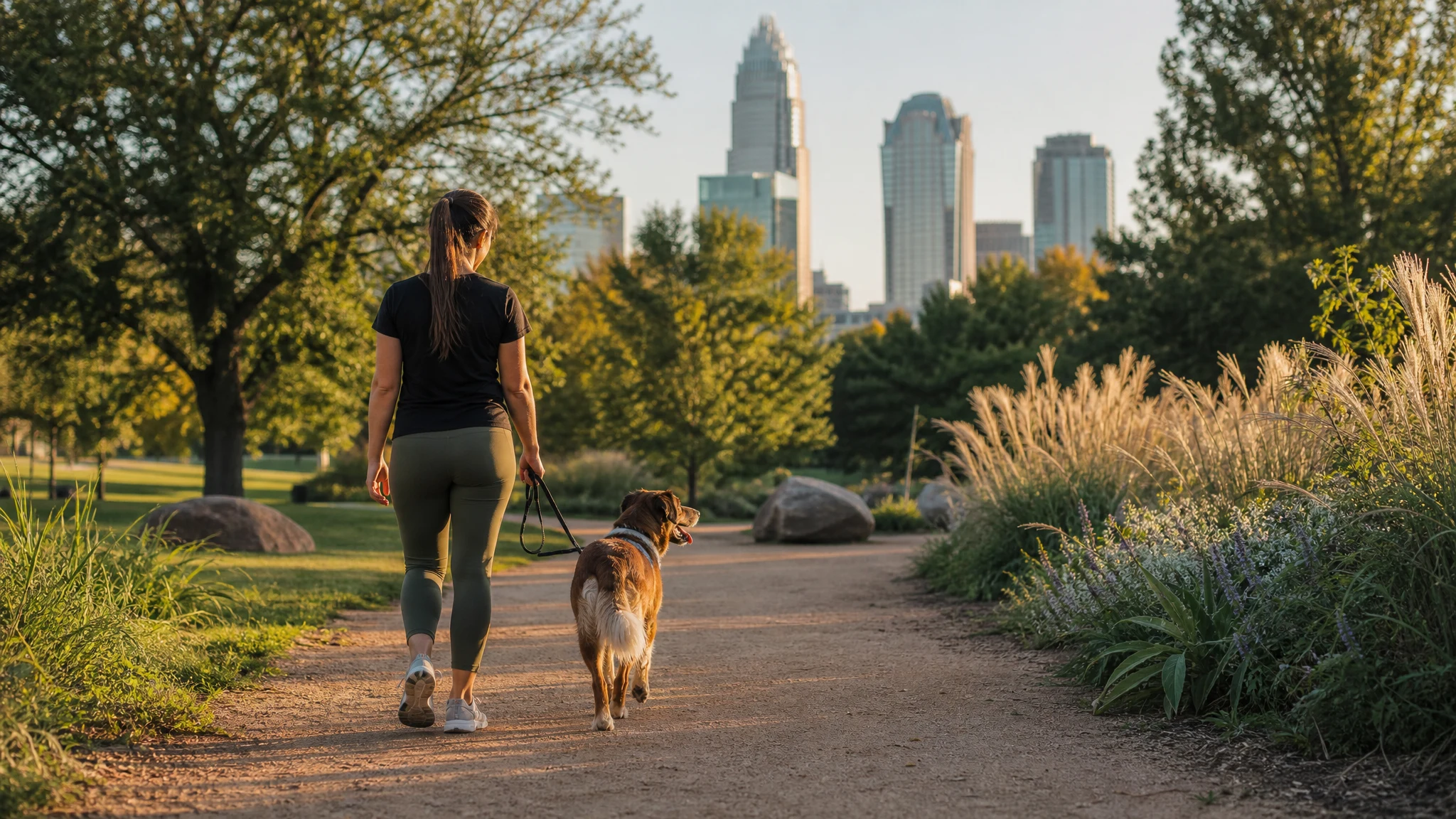
General training information. For aggression, sudden behavior changes or health concerns, see your veterinarian first.
Charlotte is a good city to train a dog in. There are greenways, county dog parks, busy sidewalks, hot summers and plenty of neighbors close by. All of that shapes what your dog needs to learn and how you go about teaching it.
This guide covers the main kinds of dog training in Charlotte, what reward-based training means, which credentials to look for, how to think about cost, and the local rules and places that affect your daily routine. It is written for owners of puppies, adopted adults and everything in between.
Key Takeaways
- Charlotte owners can choose from group classes, private lessons, day training and board-and-train. Each suits a different dog, schedule and goal.
- The American Veterinary Society of Animal Behavior (AVSAB) recommends reward-based training. Look for trainers who teach dogs what to do and avoid fear, pain or intimidation.
- Credentials such as CPDT-KA (CCPDT) and IAABC titles show a trainer has met a certifying body's standards. Ask to see them and confirm them with the issuing organization.
- No published prices were available for this guide. Ask each trainer or facility for current fees, what is included and how long a program runs.
- Charlotte and Mecklenburg County have a leash law, a pet license requirement, rabies vaccine rules and a barking nuisance rule. Training works better when you plan around them.
- Aggression toward people needs a veterinarian and a certified behavior professional, not a general obedience class.
What's in This Guide
- The Kinds of Dog Training Available
- What Reward-Based Training Is and Why It Matters
- How to Choose Among Dog Trainers in Charlotte
- Costs: What to Ask Before You Book
- Charlotte Rules That Shape Your Training
- Places and Conditions to Train Around
- A Practical Plan for Dog Obedience Training in Charlotte
- Sources
The Kinds of Dog Training Available
Most dog training in Charlotte falls into four formats. None is better in every case. The right one depends on your dog's age, history and temperament, and on how much time you can give.
Group classes
A group class puts several dogs and owners in one room with an instructor. You learn the basics together, such as sit, down, come, loose-leash walking and settling on a mat. Classes are a good fit for puppies and friendly adults who need to practice around other dogs and people.
The strength of a group class is real-world distraction. Your dog learns to focus while another dog walks past. The limit is individual attention. If your dog is very fearful or reactive, a busy room can make things harder.
Many facilities require vaccine records before your dog joins. For example, the Humane Society of Charlotte says proof of DHPP, rabies and bordetella vaccines must be on file for all dog classes. It says puppies can join at 16 weeks old and the same vaccines apply. Other facilities may ask for different things, so check with each one before you enroll.
Private lessons
In a private lesson, a trainer works with you and your dog alone, often in your home or neighborhood. This format suits specific goals: pulling on the leash, door manners, jumping on guests or a dog who is nervous around strangers.
Private work lets the trainer see the real setting where the problem happens. It also puts you at the center, which matters because you are the one who will practice every day.
Day training
In day training, a trainer works with your dog during the day while you are at work or busy, then coaches you on how to keep the skills going. Some owners like this when their schedule is tight.
The catch is that your dog learns the skills with the trainer, not with you. Ask how the hand-off works and how many sessions you get to practice with your dog before the program ends.
Board-and-train
In board-and-train, your dog stays with the trainer for a period, often days to weeks, and receives daily training. It can appeal to owners who are short on time or struggling.
It also carries more questions. Ask where your dog will sleep, who will be with them, what a typical day looks like and what methods are used. Ask what happens if your dog gets sick or stressed. Ask how the trainer will teach you to keep up the skills at home, because behavior learned in one place does not always carry over to another without practice.
Be cautious about any program that will not let you see where your dog will stay or describe its methods plainly.
Which format fits your dog?
| Format | Often suits | Think about |
|---|---|---|
| Group class | Puppies and social adult dogs, general manners | Busy setting; less one-on-one time |
| Private lesson | Specific problems, nervous dogs, home-based issues | Needs your steady practice between sessions |
| Day training | Busy owners who still want to be involved | Ask how skills are handed over to you |
| Board-and-train | Owners short on time who want intensive work | Ask about housing, methods and follow-up |
What Reward-Based Training Is and Why It Matters
Reward-based training means you teach your dog what to do and pay them for doing it. The payment can be a small treat, a favorite toy, a game or praise. When a behavior pays off, your dog does it more often.
The American Veterinary Society of Animal Behavior (AVSAB) recommends reward-based training. It also advises against punishment-based methods, because they can cause fear and stress and can make some behavior problems worse. We follow that position on this site.
What it looks like in practice
- Your dog sits, and you mark the moment with a word or click and then give a treat.
- Your dog walks beside you on a loose leash, and you reward that position often.
- Your dog is calm when a visitor arrives, and the visitor gets attention only when all four paws are on the floor.
- You manage the environment so your dog has fewer chances to practice unwanted habits, such as using a baby gate or a leash indoors.
Methods to avoid
Shock collars, prong collars and choke collars have no place in humane training. Neither do alpha rolls, scruffing or any approach built on dominating your dog. If a trainer recommends them, or describes your dog as trying to be the boss, look elsewhere.
A good trainer will explain what they are doing and why, and will welcome questions. Your dog should look relaxed and engaged in sessions, not worried or shut down.
Does reward-based mean permissive?
No. Reward-based training still has structure, clear expectations and consistency. You decide what behaviors you want, you teach them step by step, and you set up the day so your dog can succeed. The difference is that you build skills through clear communication and good outcomes, not through intimidation.
How to Choose Among Dog Trainers in Charlotte
Dog training is not a licensed profession in most places, so anyone can use the title. That is why credentials and plain answers matter when you compare dog trainers in Charlotte.
Credentials worth knowing
The CPDT-KA is a certification from the Certification Council for Professional Dog Trainers (CCPDT). The CCPDT also offers the CBCC credential for behavior consultants. The IAABC, the International Association of Animal Behavior Consultants, offers titles including IAABC-ADT (Accredited Dog Trainer) and IAABC-CDBC (Certified Dog Behavior Consultant).
A credential does not guarantee a good fit, but it shows a trainer has met a certifying body's standards and, in most cases, must keep up with continuing education. You can ask any trainer for their credential and verify it with the issuing organization.
Trainers and behavior professionals with Charlotte listings
The following are listed with Charlotte-area service and the credentials shown. This is not a ranking or a recommendation. Verify each credential and ask about methods before you book.
- Linsey Cravens, Limitless Freedom Dogs (Charlotte). Listed as CPDT-KA (CCPDT), an IACP professional member, and an AKC Canine Good Citizen and Trick Dog evaluator. See the business website.
- Sharon (Shari) Spiewak, Happy Dogs Training (Charlotte). Shown as CPDT-KA on a dogtrainerlocator.com listing that links to a CCPDT profile. The business website does not state the credential, so confirm it directly. See the business website.
- Jill Beitel (Charlotte). Shown as CPDT-KA on a dogtrainerlocator.com listing.
- Camille D Asmer, Canine Behavior Solutions (Charlotte, NC 28226). Shown as IAABC-ADT, IAABC-CDBC, CCPDT CPDT-KA and CBCC on a dogtrainerlocator.com listing. The business website shows IAABC, CCPDT and Fear Free logos.
- Valerie Licausi, Charlotte Dog Training Club. Lists CPDT-KA on the club's instructor page, a credential the club states itself. She teaches pet classes and obedience. The club is at 2273 Burkette Rd, Rock Hill, SC 29730, and serves the Charlotte area, so check the drive.
For behavior problems beyond basic manners, the listings also include Camille D Asmer (IAABC-CDBC) and Angie Cook of Canine Cohesion Behavior Services, 1015 Hills Oak Lane, Charlotte, NC 28269, shown as CDBC on a dogtrainerlocator.com listing. Her business site was not confirmed to name her or the credential, so ask her directly.
The Humane Society of Charlotte also runs dog classes. See its dog training page for current offerings.
Questions to ask any trainer
- What methods do you use, and what do you do when a dog gets it wrong?
- Do you use shock, prong or choke collars? (The answer should be no.)
- What are your credentials, and can I verify them?
- What will a first session look like, and what will I practice at home?
- How do you handle a dog who is fearful, reactive or overexcited?
- What vaccines do you require?
- What do your fees include, and what is your cancellation policy?
Be wary of anyone who promises a fixed result or a quick fix. Dogs learn at different speeds, and good trainers are honest about that.
When you need a behavior professional
If your dog growls, snaps or bites people, do not rely on an obedience class. Start with your veterinarian to rule out pain or illness, then work with a certified behavior professional. Sudden changes in behavior, such as a dog who was friendly and is now snappy, are also a reason to call the vet first.
Costs: What to Ask Before You Book
No published prices were available for this guide, so we are not going to quote dollar figures for Charlotte. Fees vary by trainer, format, program length and whether the sessions are at your home or a facility. Contact the trainer or facility for current rates.
What you can do is compare offers fairly. Ask each provider:
- What is the total cost, and what does it cover?
- For a class, how many weeks does it run, how long is each session and how many dogs are in the room?
- For a private package, how many sessions are included and how long is each?
- For board-and-train, how long is the stay, what does boarding cost and is follow-up coaching included?
- Are there extra fees for travel, equipment or vaccine records?
- What happens if you miss a session or your dog is sick?
A lower price is not always a better deal if the class is crowded or you get no follow-up. A higher price does not prove quality either. Match the program to your dog's needs and to the time you can put in at home.
Do not forget the other costs of owning a dog in Charlotte. The City of Charlotte, Animal Care and Control, publishes pet license fees, which are covered in the next section.
Charlotte Rules That Shape Your Training
Several local rules affect what you teach and how you practice. These come from City of Charlotte, Animal Care and Control, and the North Carolina General Assembly. Check the agencies directly for the full text and any updates, since rules can change.
The leash law
According to City of Charlotte, Animal Care and Control, the leash law applies in the City of Charlotte and Mecklenburg County. Animals must be on a leash or contained within a fence or a marked, operable invisible fence. Dogs must be kept on leash and under physical restraint at all times when off the owner's property. The first-violation citation is $50.
The pages we reviewed did not state a maximum leash length, so check with Animal Care and Control if you need that detail.
For training, this means a reliable recall is wonderful, but it does not replace a leash outside your yard. Practice recall on a long line in a safe place and keep your dog leashed in public.
Pet license
City of Charlotte, Animal Care and Control, says a license is required for dogs, cats and ferrets aged 4 months and older in Charlotte, Mint Hill, Pineville and unincorporated Mecklenburg County. Fees are $30 for a fertile (unsterilized) animal. For a sterilized animal, the fee is $10 for a 1-year license or $25 for a 3-year license.
You need proof of a current rabies vaccination from a veterinarian. Licenses are sold by mail or online through PetData, Inc., the city's contractor, or in person at the animal shelter.
Rabies vaccination
North Carolina law, G.S. 130A-185, requires the owner of a dog, cat or ferret over four months of age to have the animal vaccinated against rabies. Charlotte-Mecklenburg also requires proof of a current rabies vaccine to get or renew a pet license. Keep your records handy, because classes and dog parks ask for them.
Barking
The Mecklenburg County animal ordinance lists allowing an animal to bark, whine, howl, crow or cackle in an excessive, continuous or untimely fashion as a public nuisance. If your dog barks a lot, it is worth addressing early. A trainer can help you find out why, whether it is boredom, alone time or reactions to sounds outside, and teach alternatives.
Dangerous dogs and bites
According to City of Charlotte, Animal Care and Control, owners of dogs determined to be dangerous face protective measures such as secure fencing, liability insurance, warning signs and muzzling off the owner's property. Decisions are subject to due process review. Dogs that bite someone are quarantined for ten days.
This is one more reason to take warning signs seriously. If your dog is showing aggression toward people, see a veterinarian and a certified behavior professional promptly.
Other towns and keeping several pets
The ordinance applies to Charlotte, Mint Hill, Pineville and unincorporated Mecklenburg County. Davidson and other towns may have their own rules. The City's Pet Resources page also says permits are required to house 3 or more pets outdoors. Ask Animal Care and Control about the details if that applies to you.
Places and Conditions to Train Around
County dog parks
Mecklenburg County Park and Recreation runs dog parks with off-leash areas. According to the county, they are open daily from 7:30 a.m. to sunset. Dogs must have current rabies (with tag number), DHLPP and Bordetella vaccinations to use the off-leash areas, and no children under 12 are allowed in dog parks. No fee was published on the county page we reviewed.
- Davie Dog Park at William R. Davie District Park, 4635 Pineville-Matthews Road, in south Charlotte. The county blog describes a 5-acre off-leash park.
- Frazier Park Dog Park, near center city along the Irwin/Stewart Creek Greenway. It has separate areas for small and large dogs and a public water supply, and the county blog says it sits on 1.3 acres. Dogs must be leashed on the greenway.
- Shuffletown Dog Park and Clarks Creek Dog Park. The county pages we reviewed did not list park addresses, so check the county's dog parks page for directions.
A dog park is a place to use skills, not to build them. Teach your dog to come when called and to settle in quieter places first. Then visit at a calm time, watch the body language of every dog and leave if play gets rough or your dog seems overwhelmed.
Summer heat
Charlotte summers are hard on training plans. In a WSOC-TV report on extreme heat, Charlotte Mecklenburg Animal Care and Control advised avoiding hot pavement or asphalt at peak heat because it can burn paws. The agency also advised walking pets in cooler hours, early morning or late evening, never leaving pets in parked cars and bringing pets indoors in extreme heat. The report said failing to do so may lead to animal abuse charges in the county.
Schedule outdoor sessions early or late. On hot days, switch to indoor games like scent work, name recognition and short mat-settle sessions. If your dog shows heavy panting, stumbling or collapse, treat it as an emergency and contact a veterinarian right away.
Ticks
A 2020 WFAE report on North Carolina ticks says the blacklegged tick has been found in Mecklenburg County. It notes that Rocky Mountain spotted fever occurs largely in central and eastern NC, and that the Lone Star, brown dog and American dog ticks also occur in the state.
NC State Extension advises using a product that works on both fleas and ticks, chosen with a veterinarian, and not combining products. If you train on greenways or in tall grass, check your dog for ticks afterward.
Shelters and adopted dogs
If you adopted recently, your dog may need extra time to settle before training takes off. Charlotte-Mecklenburg Animal Care & Control runs a main shelter at 8315 Byrum Dr, Charlotte, NC 28217, and a satellite shelter at 2700 Toomey Avenue, Charlotte, NC 28203. The satellite is listed as open daily from 9:00 a.m. to 5:00 p.m. For main shelter hours and phone details, see the adoption page, since hours may change.
Give a new dog a quiet routine, short sessions and lots of rewards for easy wins. Ask your veterinarian about any health concerns before you start.
A Practical Plan for Dog Obedience Training in Charlotte
Dog obedience training in Charlotte works best when it fits your daily life. Here is a simple way to get started.
Step 1: Get the basics in order
Make sure your dog has a current rabies vaccination, a pet license if they are 4 months or older, and a vet check. These are required for classes, dog parks and Charlotte-Mecklenburg compliance anyway.
Step 2: Pick your first format
For a puppy or a friendly adult, a group class is a common starting point. For a dog with a specific problem, a private lesson is usually more helpful. For a dog who bites or threatens people, start with your vet and a certified behavior professional.
Step 3: Choose a trainer you can talk to
Use the questions earlier in this guide. Watch a class if the facility allows it. Pay attention to how the dogs look and how the instructor speaks to the owners.
Step 4: Practice in short bursts
Five minutes a few times a day usually beats one long session. Use real life: ask for a sit before meals, before the door opens and before the leash goes on.
Step 5: Add distractions slowly
Move from your living room to the yard, then a quiet street, then a busier sidewalk. If your dog stops responding, go back a step. This is normal, not failure.
Step 6: Keep skills fresh
Training does not end when the class does. Keep rewarding good behavior, especially in new places. Many owners return for a next-level class or a refresher lesson when life changes, such as a move or a new baby.
Final Thoughts
Good training is about understanding your dog, setting clear expectations and rewarding what you want to see more of. In Charlotte, it also means knowing the leash law, keeping up with the license and rabies rules, and planning around the heat and the ticks.
Take your time comparing options. Ask questions, check credentials and pick a trainer whose methods match the humane approach AVSAB recommends. Progress comes in small steps, and every one of them counts.
Sources
- City of Charlotte, Animal Care and Control, Mecklenburg County Animal Ordinance
- City of Charlotte, Animal Care and Control, Pet License
- City of Charlotte, Animal Care and Control, Pet Resources
- North Carolina General Assembly, G.S. 130A-185
- Mecklenburg County Park and Recreation, Dog Parks
- Mecklenburg County blog, Dog Days
- Charlotte-Mecklenburg Animal Care & Control
- Charlotte-Mecklenburg Animal Care & Control, Adopt a Pet
- Humane Society of Charlotte, Dog Training
- WSOC-TV, How to protect your pets during extreme heat (June 24, 2025)
- WFAE, Ticks continue creeping southward in North Carolina (Aug 6, 2020)
- NC State Extension Entomology, Time for Tick Treatments