Help for a Reactive or Aggressive Dog in Charlotte
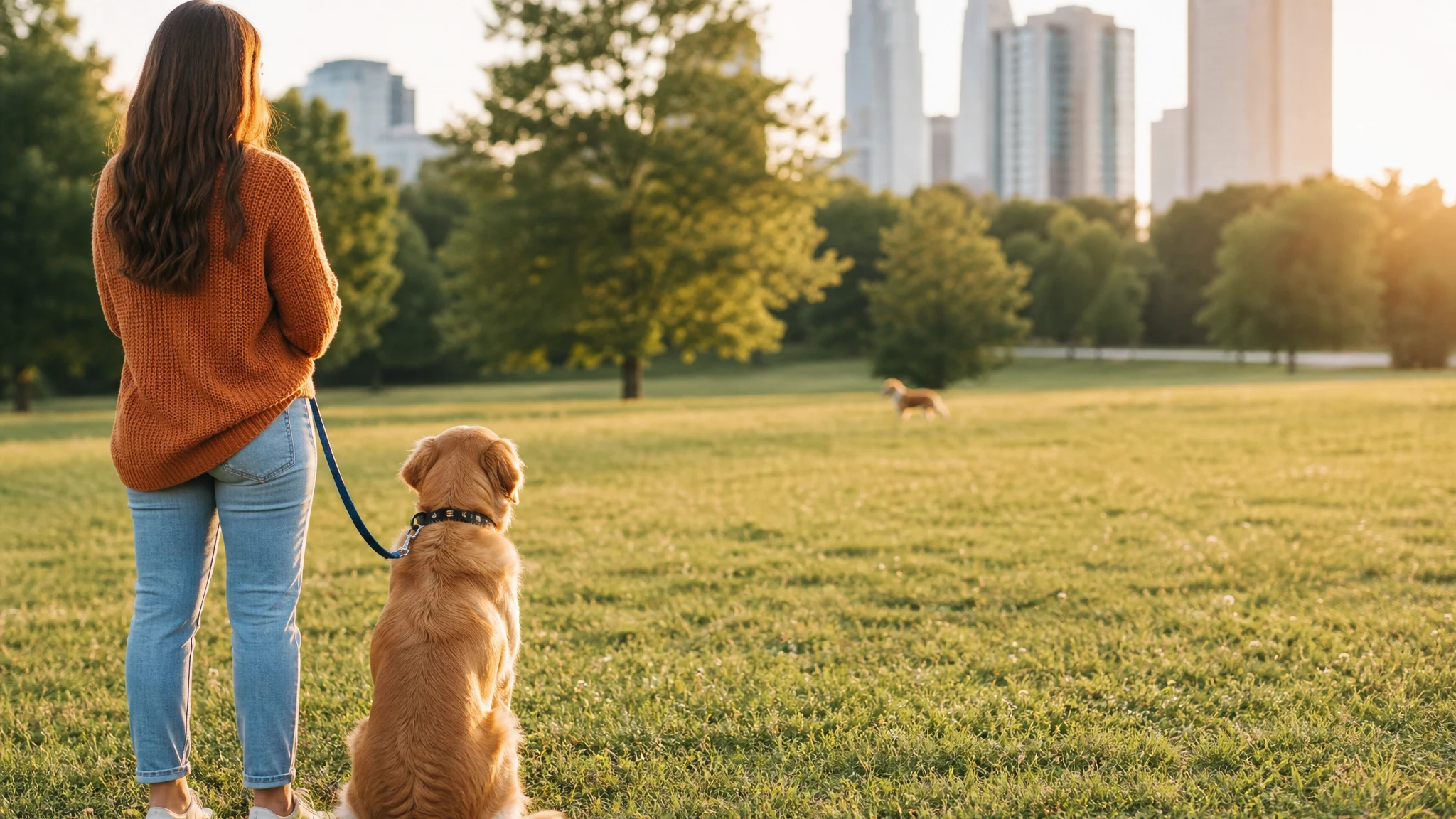
General training information. For aggression, sudden behavior changes or health concerns, see your veterinarian first.
If your dog lunges, barks or growls at other dogs, people, bikes or skateboards, you are not alone. Walking a reactive dog on a busy Charlotte street or greenway can feel stressful. The good news is that many dogs improve with patient, reward-based work.
This guide covers what reactivity and aggression are, how to keep everyone safe, and how to start reactive dog training at home. It also explains when to call a veterinarian and where to look for local professionals.
What reactivity and aggression mean
Reactivity means a dog overreacts to a trigger. Common triggers are other dogs, strangers, bikes, cars and sudden noises. The dog may bark, lunge, spin or freeze. Many reactive dogs are scared, frustrated or overexcited, not "bad."
Aggression is behavior meant to create distance or cause harm, such as snarling, snapping or biting. Reactivity can turn into aggression if a dog feels trapped and the warnings do not work. The two overlap, but they are not the same thing.
Either way, the dog is communicating discomfort. Our job is to change how the dog feels about the trigger, not to scare the behavior out of them.
Safety first
Safety comes before training. A bite can hurt a person or another dog, and it can have legal consequences for you.
- Keep your dog leashed off your property. The City of Charlotte, Animal Care and Control, says the leash law applies in Charlotte and Mecklenburg County. Dogs must be on a leash or inside a fence, or a marked and working invisible fence. Dogs must be under physical restraint at all times off the owner's property. The city lists a $50 citation for a first violation.
- Know the dangerous dog rule. According to the City of Charlotte's summary of the Mecklenburg County animal ordinance, owners of dogs determined to be dangerous face protective measures. These include secure fencing, liability insurance, warning signs and muzzling off the owner's property. Decisions are subject to due process review. The same source says a dog that bites someone is quarantined for ten days. For the exact definitions and the appeal process, check with Charlotte-Mecklenburg Animal Care and Control.
- Manage the environment. Use baby gates, closed doors or a crate when visitors come. Do not rely on a dog "being fine" if there has been a bite or a close call.
- Watch your dog's body language. Stiff posture, a hard stare, lip licking, whale eye (showing the whites of the eyes) and a closed mouth often come before a bigger reaction.
If your dog has bitten or seriously threatened a person, skip the do-it-yourself plan for now. See a veterinarian and a certified behavior professional first (more on that below).
Why punishment makes it worse
The American Veterinary Society of Animal Behavior (AVSAB) recommends reward-based training and advises against punishment-based methods for behavior problems. Punishment can suppress the warning signs, such as growling, without changing the fear underneath. A dog that has learned not to growl may skip straight to a bite.
It can also teach the dog that the trigger predicts bad things. If your dog is yanked or shocked when another dog appears, other dogs become even scarier.
For that reason, avoid shock, prong and choke collars, alpha rolls, scruffing and any "dominance" approach. A good trainer will not use them either.
Materials you will need
- A flat collar or a well-fitted harness, plus a standard 4 to 6 foot leash. Avoid retractable leashes, since they give you little control.
- Small, soft, high-value treats such as tiny pieces of cooked chicken or cheese. They should be much better than the dog's everyday kibble.
- A treat pouch so rewards come out quickly.
- A notebook or phone to log triggers, distances and progress.
- Optional: a basket muzzle that your dog has been gradually and happily conditioned to wear. Never force one on. Your veterinarian or a certified professional can show you how to introduce it.
- A quiet place to practice, such as a low-traffic street or a large parking lot at an off-peak hour.
Step-by-step: starting reactive dog training at home
These steps use two classic tools: desensitization and counter-conditioning. Desensitization means exposing your dog to a trigger at a level so low it does not cause a reaction. Counter-conditioning means pairing that trigger with something wonderful, so the dog's feelings change over time.
Step 1. Rule out pain and illness
Book a veterinary visit before you begin. Pain, thyroid problems, ear infections and other medical issues can make a dog touchy or edgy. Ask your veterinarian whether a medical cause could be involved, and mention every trigger and incident you have seen.
Step 2. Find your dog's threshold
The threshold is the distance at which your dog notices a trigger but can still eat treats and respond to you. Past that distance, your dog is "over threshold" and cannot learn. Notice how far away the trigger is when your dog first stiffens or stares. Your starting distance should be farther than that. It might be across a big parking lot, not across the street.
Step 3. Teach a few easy skills in a calm place
Practice indoors or in the yard first. Teach your dog to:
- Look at you when you say their name or a cue like "watch."
- Touch your hand with their nose.
- Turn and walk away with you using a cheerful "let's go."
Reward every success. These skills become your exit plan when a trigger appears.
Step 4. Pair the trigger with treats at a safe distance
Go to a spot where you can see a trigger from well beyond your dog's threshold. When your dog sees the trigger, start feeding treats. When the trigger disappears, the treats stop. The pattern you are building is "trigger appears, chicken appears."
Keep sessions short, about five minutes, and end while your dog is still relaxed.
Step 5. Watch for a relaxed response
When your dog sees the trigger and then looks back at you for a treat, that is a good sign. Their body should look loose, and their mouth should be soft. Those are signs the emotional response is changing.
Step 6. Decrease distance very gradually
Only when your dog is relaxed at one distance should you try a little closer. Move in small steps, a few feet at a time, over many sessions. If your dog reacts, you went too fast. Calmly increase distance, reward the first moment your dog can focus again, and make the next attempt easier.
Step 7. Use the exit plan when needed
If a trigger appears suddenly, turn away with a cheerful voice, drop a few treats on the ground or lead your dog away to a safe distance. Retreating is not failing. It protects your dog's trust in you.
Step 8. Keep track and be patient
Write down the trigger, distance and reaction for each session. Progress is rarely a straight line. A bad day does not erase your earlier work.
Tips for success
- Avoid the triggers you cannot control while you train. Walk at quieter times, cross the street early or turn around. In summer, Charlotte Mecklenburg Animal Care and Control advises walking pets in the cooler early morning or late evening hours, and avoiding hot pavement that can burn paws. That quieter timing may also mean fewer surprise encounters.
- Be careful with dog parks. Mecklenburg County Park and Recreation lists current rabies (with tag number), DHLPP and Bordetella vaccinations as requirements for its off-leash areas, and says children under 12 are not allowed. Even when your dog meets those rules, a busy off-leash space is usually too much for a dog who is still working on reactivity. Many owners wait until a professional says it is a good idea.
- Reward calm choices. Notice and pay for the moments your dog chooses to look away from a trigger.
- Keep your own breathing steady. A tight leash and a tense body can add to your dog's stress.
- Protect rest and sleep. Stressed dogs often cope better after good rest and enough physical and mental exercise, like sniffing walks and food puzzles.
Common mistakes to avoid
- Going too close, too soon. This is the most common mistake. Distance is your best tool.
- Letting strange dogs say hello. Greeting on leash often escalates things. Politely tell other owners that your dog needs space.
- Correcting growling. A growl is useful information. Back up, give space and work out what is bothering your dog.
- Using harsh tools. Shock, prong and choke collars can raise stress and make aggression more likely.
- Skipping the vet. Hidden pain is a common contributor.
- Expecting a quick fix. Reactive dog training usually takes weeks to months, and some dogs need ongoing management.
What results to expect
Many dogs become calmer, recover faster and can handle triggers at shorter distances with consistent, reward-based practice. Some dogs improve a lot. Others learn to cope but still need careful management for life. Results depend on your dog's history, genetics, health and the consistency of your training, and nobody can promise a particular outcome.
When to see a veterinarian or a veterinary behaviorist
Call your veterinarian promptly if:
- The behavior started suddenly or got worse quickly.
- Your dog seems to be in pain, is limping or has changes in appetite, sleep or bathroom habits.
- Your dog has bitten or tried to bite, or you feel unsafe.
For aggression toward people, involve both a veterinarian and a certified behavior professional. Ask your veterinarian whether a referral to a veterinary behaviorist, a veterinarian with advanced training in behavior, makes sense. They can look at medical factors and discuss whether medication might support a training plan. I do not have a Charlotte veterinary behaviorist to point you to, so ask your regular veterinarian for a referral.
Any bite, whether to a person or an animal, is also a good moment to check the county ordinance. Contact Charlotte-Mecklenburg Animal Care and Control about quarantine and reporting rules.
Local professionals in Charlotte
Look for someone who uses reward-based methods, will explain their plan, and is willing to work with your veterinarian. Always confirm credentials with the certifying body and ask what tools and methods they use. The listings below are based on the credentials each professional has published. This is not a ranking or an endorsement.
Behavior professionals
- Camille D Asmer, Canine Behavior Solutions, 6600 Brookmeade Dr., Charlotte, NC 28226. She is listed with IAABC-CDBC (certified dog behavior consultant) and also IAABC-ADT, CCPDT CPDT-KA and CBCC. See Canine Behavior Solutions.
- Angie Cook, Canine Cohesion Behavior Services, 1015 Hills Oak Lane, Charlotte, NC 28269. She is listed as a CDBC on her dogtrainerlocator.com listing. Confirm her credential and services directly with her.
Certified trainers
- Linsey Cravens, Limitless Freedom Dogs, Charlotte. CPDT-KA (CCPDT), IACP professional member, and AKC Canine Good Citizen and Trick Dog evaluator. See Limitless Freedom Dogs.
- Sharon (Shari) Spiewak, Happy Dogs Training, Charlotte. Listed as CPDT-KA on dogtrainerlocator.com. Her business site is Happy Dogs Training, which does not state the credential, so confirm it with her.
- Jill Beitel, Charlotte. Listed as CPDT-KA on dogtrainerlocator.com.
- Valerie Licausi, Charlotte Dog Training Club, an instructor for pet classes and obedience. She states CPDT-KA on the club instructor page. The club is at 2273 Burkette Rd, Rock Hill, SC 29730, and serves the Charlotte area.
Ask each person whether they work with reactive or aggressive dogs. Some trainers focus on basic manners and may refer you on for serious behavior cases. For help comparing group classes, private lessons and what to ask before you sign up, see our guide to dog training in Charlotte: classes, costs and how to choose.
Reactive dogs often do better in private sessions or specialized classes than in a busy group class. Ask a professional what setting fits your dog. For any class, expect to show vaccine records. The Humane Society of Charlotte, for example, asks for proof of DHPP, rabies and bordetella vaccines for all dog classes. Other facilities may differ, so ask before you go.
Keep up your legal basics
While you work on behavior, keep the paperwork in order. The City of Charlotte, Animal Care and Control, says dogs aged 4 months and older need a license in Charlotte and unincorporated Mecklenburg County, with proof of a current rabies vaccination. State law (G.S. 130A-185) requires rabies vaccination for dogs over four months old. Check the city's Pet License page for current fees.
The Mecklenburg County animal ordinance also lists excessive, continuous or untimely barking as a public nuisance. A dog who barks a lot at passersby may need management, like blocking the view from a window or fence, while training continues.
Sources
- City of Charlotte, Animal Care and Control, Mecklenburg County Animal Ordinance
- City of Charlotte, Animal Care and Control, Pet License
- North Carolina General Assembly, G.S. 130A-185
- Mecklenburg County Park and Recreation, Dog Parks
- WSOC-TV, How to protect your pets during extreme heat (quoting Charlotte Mecklenburg Animal Care and Control)
- Humane Society of Charlotte, Dog Training
- Canine Behavior Solutions
- Angie Cook, dogtrainerlocator.com listing
- Limitless Freedom Dogs
- Charlotte Dog Training Club, Instructors